









Turn AI readiness into action
AURA is an evidence-informed self‑assessment that helps you understand your organization’s AI utilization readiness—your ability to adopt and scale AI (including Generative AI) in ways that are responsible, systematic, and useful in real work.
Designed for Enterprise Environments


AI Initiatives Stall For Predictable Reasons
Many organizations experiment with AI, but results don’t scale— because readiness is treated as a tech decision, not an organizational capability. AURA helps you define what’s needed to make AI work reliably and responsibly.
Skills and adoption lag behind tooling
AI use is not integrated into core workflows (“pilot purgatory”)
Outcomes aren’t measured consistently, so learning doesn’t compound
Data foundations and access are inconsistent across teams
Governance, risk, and ethical controls are unclear or uneven
Partnerships and ecosystem support are underutilized
AURA Is The
Assessment.
AURI is the readiness index
AURA (Assessment)
A structured evaluation of your AI utilization readiness across seven dimensions—designed to be completed by an institution using clear maturity choices and optional evidence notes.
- Standardized question design (maturity-based choices)
- Evidence prompts to reduce guesswork
- Built for independent completion or facilitated delivery
AURI (Index)
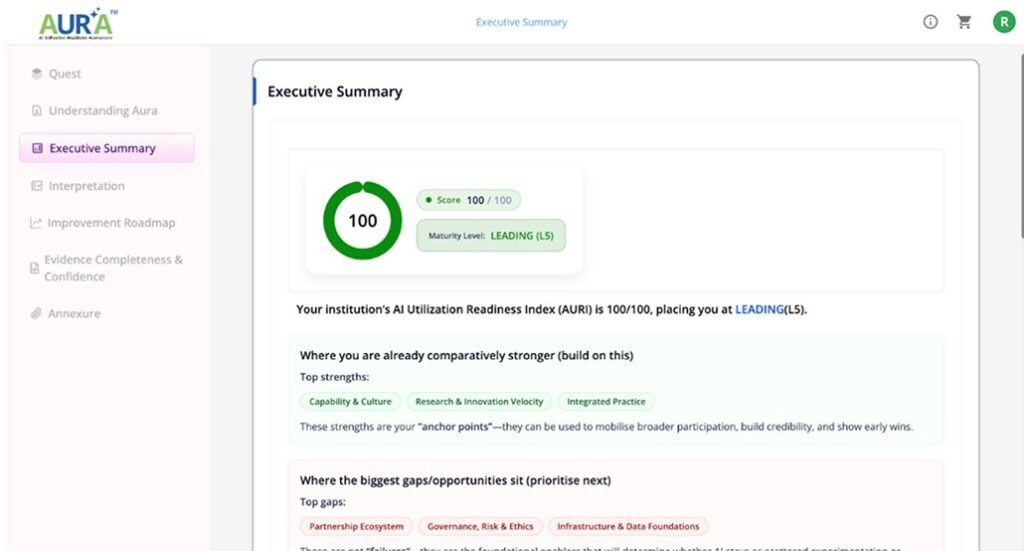
The AI Utilization Readiness Index—your consolidated score and band that summarizes where you stand today and where to focus next.
- 0–100 score plus readiness band
- Dimension-level diagnostics (not just one number)
- Progress tracking across reassessments
Built To Serve
Multiple Sectors
—
Delivered In Editions
Multiple Sectors —
Delivered In Editions
AURA is designed as a common readiness language across sectors, with editions that reflect different operating realities
Academic Institutions
Readiness for teaching, research, and administration— grounded in real academic contexts.
Enterprises (Large)
Portfolio-level readiness across business units, governance, and scalable adoption.
SMBs
Fast clarity on where to invest first—skills, data foundations, governance basics.
Government & Public Sector
Readiness with accountability, transparency, and public-impact considerations.
NGOs & Civil Society
AI utilization aligned to mission outcomes, inclusion, and responsible practice.
Individuals (Professionals)
Personal capability and readiness pathways to lead AI adoption responsibly.
How It
Works
A clear process, designed for real organizations.
Assess
Assess across stakeholders
Invite key contributors, complete the assessment, and capture evidence notes where available.
Understand
See your AURI and priority gaps
Review the executive summary, dimension insights, and evidence confidence—so discussions are based on shared facts, not opinions.
Improve
Act on a staged roadmap
Use the improvement roadmap to choose a small number of high‑leverage moves, assign owners, and re‑assess on a repeatable cadence.
Seven Dimensions That Define
AI Utilization
Readiness
AI Utilization Readiness
AURA measures readiness across Essentials (foundational internal capability) and Scale
(the enablers that sustain and expand AI utilization).
Essentials
- Capability & Culture — skills, mindset, leadership support, cross-functional collaboration
- Integrated Practice — AI embedded into strategy and day-to-day workflows
- Research & Innovation Velocity — ability to experiment, learn, and adopt new AI methods
- Measurement & Learning Loop — metrics, monitoring, and continuous improvement
Scale
- Infrastructure & Data Foundations —data quality, access, platforms, scalability
- Governance, Risk & Ethics — guardrails for responsible, compliant, trustworthy AI
- Partnership Ecosystem— external collaborations that accelerate adoption and capability
Outputs
Built For
Leadership Decisions
And Working Teams
Leadership Decisions
And Working Teams
AURI score + readiness band
A single score supported by dimension detail—useful for executives and boards.
Executive summary (ready to share internally)
Clear narrative: where you are, what’s strongest, what to prioritize next.
Dimension-by-dimension interpretation
See which parts of readiness are holding back adoption and scale.
Evidence completeness & confidence view
Distinguish between “low maturity” and “low evidence,” and plan how to strengthen both.
Improvement roadmap (30/90/6/12 months)
Action steps sequenced so progress is practical, staged, and measurable.
Annexure / supporting notes
Capture your supporting context, assumptions, and internal references.
Your
Data
Stays Yours
Results are private by default and shared only with people you invite
Designed to support internal decision-making and planning
Suitable for organizations that require clear governance and accountability
Sample Security and deployment details available on request (enterprise and public sector)ential/certificate view
Resources To Support Internal Alignment
From
Readiness
Insight To Capability Building
AURA gives you the baseline and the roadmap. If you want support executing the roadmap, Ripples can help through the
broader ecosystem
Ripples Learning
Capability programs, workshops,
and role-based pathways aligned to readiness gaps
Ripples Credentials
validate proficiency and scale capability across cohorts.
Ripples Research
Use diagnostics and impact
measurement to show what changed after interventions
Designed
For The Full Buying Committee
For HR / Talent leadership (CHRO / HR Heads)
- Build workforce readiness without relying on ad-hoc tool adoption
- Clarify role-based capability needs and change readiness
- Support governance, ethics, and risk alignment across teams

For L&D leaders
- Translate readiness gaps into training priorities and pathways
- Build a repeatable “assess → develop → measure” rhythm
- Generate artifacts leadership can act on (not just attendance reports)
For Business / Functional leaders
- Identify where AI can realistically be integrated into execution
- Reduce “pilot purgatory” by focusing on adoption and workflow integration
- Prioritize high-leverage moves tied to business outcomes

For IT / Data leadership
- Make data and infrastructure gaps visible and prioritized
- Create alignment on platform, access, and scale requirements
- Connect readiness to responsible deployment and monitoring

For Risk / Compliance
- Surface governance and oversight gaps early utilization scales
- Support responsible AI guardrails as
- Clarify where evidence is strong vs. missing

For Procurement / Finance
- Clear deliverables, repeatable cycles, and optional service layers
- Lower risk through transparency (methodology + confidence view)
- Flexible deployment models (self-serve, facilitated, cohort)

Frequently Asked Questions
What exactly does AURA measure?
AURA measures AI utilization readiness—your ability to adopt and scale AI effectively and responsibly across culture, practice, innovation, measurement, data foundations, governance, and partnerships.
Is this only for technology teams?
No. AI readiness is organizational. AURA is designed for cross-functional participation—leadership, IT/data, operations, HR/L&D, and risk.
Is AURA a certification or an audit?
AURA is a diagnostic assessment. It is not a certification or compliance verdict unless you separately commission verification.
Do we need perfect evidence to start?
No. AURA makes evidence completeness visible so you can separate “low maturity” from “low evidence” and improve both over time.
How do we use the results?
Most teams use the executive summary to align leadership, then choose 3–5 priority moves from the roadmap, assign owners, and re-assess on a defined cadence.
Can we use AURA for a department or unit, not the whole organization?
Yes. You can scope AURA to an institution, division, or function—then expand as needed.
Does AURA include Generative AI?
AURA considers Generative AI as part of utilization readiness where relevant. Dedicated GenAI modules may be offered as editions or add-ons.
Can consultants or associations use AURA with clients/members?
Yes. AURA supports partner delivery models (facilitated use, cohorts, and programs). Partner options are available.
How often should we reassess?
Many organizations reassess every 6–12 months to track progress and keep readiness aligned
Start with a baseline you can act on.
Run AURA to establish a shared view of AI readiness, prioritize what matters, and build a repeatable improvement rhythm.